
-
Types of Glands
Glands are fascinating and essential parts of our bodies, each with unique roles and features. They can be classified based on their structure, similar to the epithelia, but also the type of secretion they produce, and how they release it. Understanding these differences helps us appreciate how our bodies function and stay healthy. Let’s dive Continue reading
-
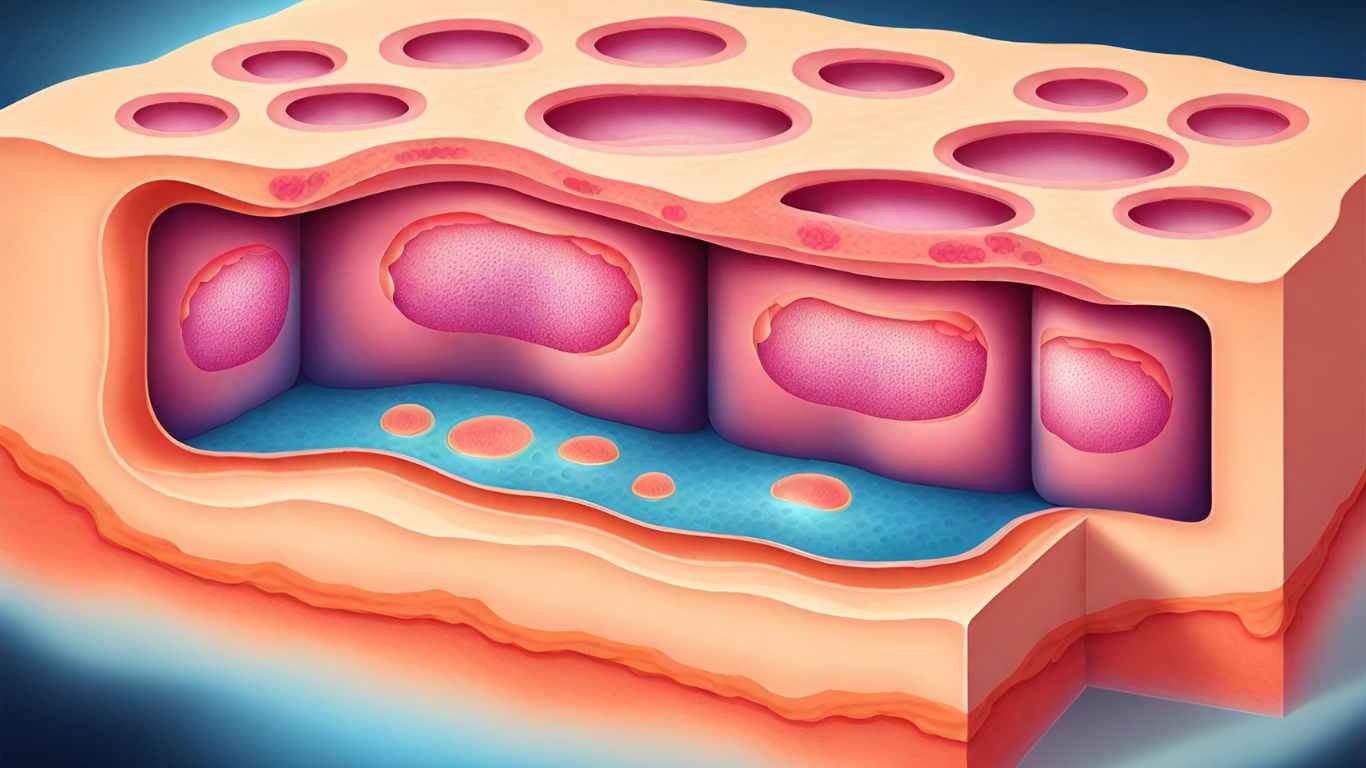
Types of Epithelium
Epithelium is what covers all the internal and external surfaces of our bodies. This article dives into the diverse types of epithelium, from simple squamous to transitional, understanding their structures and functions. Learn about their locations and roles in various bodily systems. To learn how to correctly identify and name epithelia, see the article on Continue reading
Category: Epithelial Tissue
The Body’s First Line of Defense: Exploring the specialized cellular sheets that cover, line, and protect.
Epithelial tissue, or epithelium, consists of closely packed cells with very little extracellular matrix. It forms the boundaries between our body and the external environment, lining every internal cavity and covering every external surface. From secretion in glands to absorption in the intestines, its versatility is central to human physiology.
Key Characteristics
- Cellularity: Cells are bound closely together by specialized junctions.
- Polarity: Features an Apical surface (top) and a Basal surface (bottom).
- Avascularity: Contains no blood vessels; nutrients are received via diffusion from underlying connective tissue.
- Regeneration: Highly mitotic; rapidly replaces damaged or lost cells.
Classification System
Epithelium is classified based on the number of layers and the shape of the cells at the apical surface:
By Layering:
- Simple: A single layer (absorption/filtration).
- Stratified: Multiple layers (protection).
- Pseudostratified: Appears layered, but all cells touch the basement membrane.
By Cell Shape:
- Squamous: Flat and scale-like.
- Cuboidal: Box-like, as tall as they are wide.
- Columnar: Tall and rectangular.
Clinical Context
Most cancers (roughly 90%) originate in epithelial tissues and are known as carcinomas. Because these cells divide rapidly and are constantly exposed to environmental carcinogens (like UV light or smoke), they are the most common site for malignant transformation.