
-

Anatomical Terminology
Anatomical terminology forms the foundation of communication within the field of anatomy and provides a standardized language for describing the structures and relationships within the human body. From directional terms to specific anatomical regions and landmarks, mastering these terms is essential for precise and effective communication among healthcare professionals, researchers, and anatomists. In this article, Continue reading
-
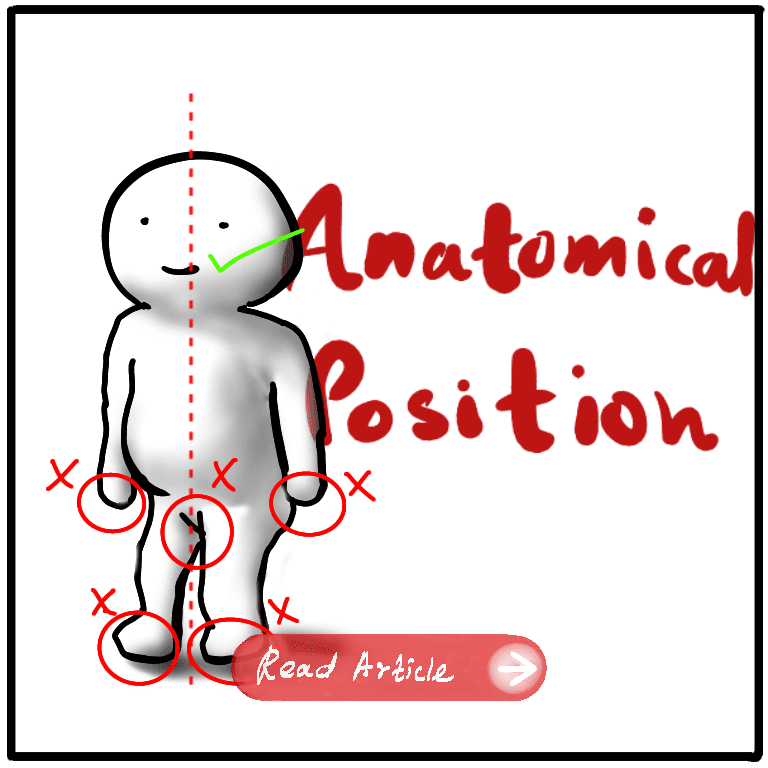
Anatomical Position
This article discusses the do s and don’t s in the correct anatomical position. Its history, and common misconceptions and a quiz! Continue reading
-
Introduction To Anatomy
Anatomy is a subject which requires a lot of spatial intelligence, the ability to read and understand how structures are arranged in a three-dimensional space. The process of understanding becomes quite easy when done in combination with 3D models , pictures and cadaveric dissection. Memorizing, however, is more effectively done when reading the subject matter. Continue reading
Category: Anatomy Basics
Mastering the Universal Language: Establishing the fundamental orientation, terminology, and structural hierarchy of human anatomy.
Anatomy is more than just a map of the body; it is a precise language. Before diving into specific systems, medical students must master the Anatomical Position and the directional terms that allow clinicians to communicate findings without ambiguity.
Standard Orientation
All anatomical descriptions are based on the Anatomical Position (standing erect, feet forward, palms facing front).
- Superior/Inferior: Above and below.
- Anterior/Posterior: Front and back (Ventral/Dorsal).
- Medial/Lateral: Toward or away from the midline.
- Proximal/Distal: Nearer to or farther from the trunk/attachment point.
Body Planes & Sections
To visualize internal structures, the body is divided into imaginary flat surfaces called planes:
- •
Sagittal Plane: Divides the body into right and left portions (Midsagittal is exactly in the middle). - •
Frontal (Coronal) Plane: Divides the body into anterior (front) and posterior (back) portions. - •
Transverse (Axial) Plane: Divides the body into superior (top) and inferior (bottom) portions.
The “Why”
In clinical practice, these basics are essential for interpreting radiological imaging (CT/MRI slices) and documenting physical examinations. A “lateral” pain versus a “medial” pain can point toward entirely different organ systems or pathologies.