
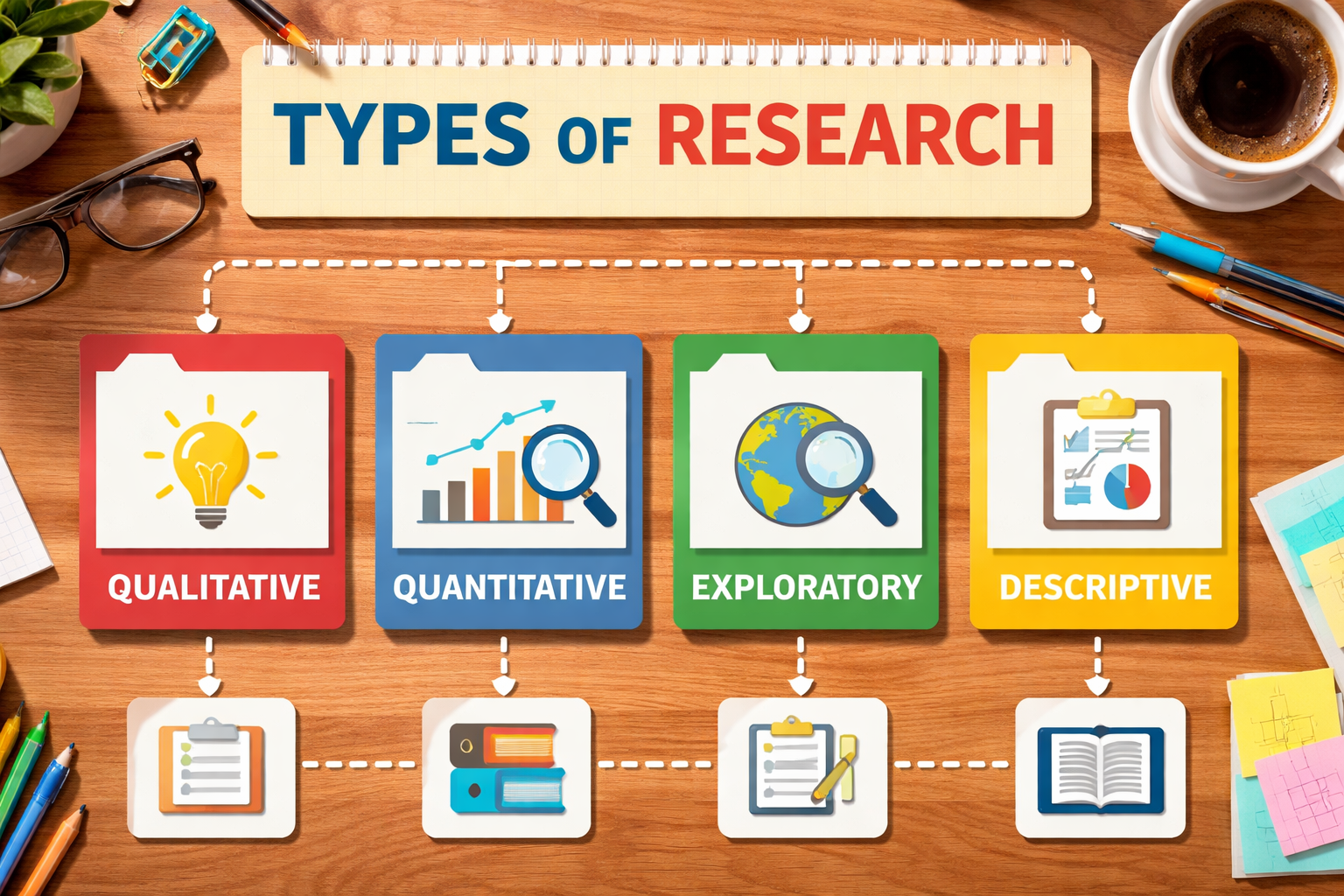
Entering the world of medicine involves more than just memorizing anatomy or pharmacology; it involves understanding how that knowledge is created. As a medical student, you will encounter various types of research throughout your career. Whether you are reading a textbook or analyzing a new drug trial, recognizing the origin of the data is crucial. This article breaks down the complex world of scientific inquiry into clear, manageable categories for your journey. While we will cover the specific hierarchy of evidence in a future article, understanding these fundamental definitions is your first step.
The Broad Classifications
Before analyzing specific study designs, we must first categorize how researchers approach their questions. These broad categories define the nature of the data itself.
Primary vs. Secondary Research
Research generally falls into two buckets: primary and secondary. Primary research involves the direct collection of raw data to answer a specific question [1]. This is the “front line” of discovery. Conversely, secondary research evaluates and synthesizes existing data from multiple primary studies [1].
Quantitative vs. Qualitative
Furthermore, we distinguish methods by the type of data they produce.
- Quantitative Research: This method focuses on numbers and objective measurements. It asks “how many?” or “how much?” and uses statistics to test hypotheses [2].
- Qualitative Research: In contrast, this explores the “why” and “how” of human experience. It relies on interviews and observations to provide narrative data that numbers cannot capture [2].
Basic vs. Clinical Sciences
Finally, we divide primary work into basic and clinical sciences. Basic research, often called “bench” research, explores fundamental rules of life in a lab setting [3]. Clinical research, however, directly involves people to improve diagnosis and treatment [3].
The Element of Time: Retrospective vs. Prospective
Another key distinction in the different types of research is the direction of time.
- Retrospective Studies: These look backward. Researchers analyze data that already exists, such as past medical records, to link past exposures to current disease [4].
- Prospective Studies: These look forward. Researchers recruit participants and follow them into the future to observe outcomes as they happen [4].
Observational Studies: Watching and Waiting
In observational studies, researchers monitor participants without changing their environment or introducing treatments [5]. In other words, they “observe” nature taking its course.
Cross-Sectional Studies
Think of this as a snapshot. A cross-sectional study analyzes data from a population at a single specific point in time [5]. It is excellent for determining the prevalence of a disease but cannot prove causation.
Case-Control Studies
These studies are retrospective. Researchers start with people who already have a disease (“cases”) and compare them to similar people without it (“controls”) [6]. They look back in time to see if the cases were exposed to a specific risk factor.
Cohort Studies
Cohort studies are typically prospective. Researchers identify a group of people (a cohort) who do not have the disease yet. They classify them by exposure (e.g., smokers vs. non-smokers) and follow them over time to see who gets sick [6].
Experimental Studies: Intervening for Answers
Experimental studies actively intervene. Researchers introduce a treatment to see if it causes a change. This is the gold standard for establishing cause and effect.
Randomized Controlled Trials (RCTs)
In an RCT, participants are randomly assigned to groups. One group receives the active intervention, while the other receives a control (like a placebo) [7]. Randomization ensures that the only difference between the groups is the treatment itself.
Quasi-Randomized and Quasi-Experimental
Sometimes, true randomization is impossible or unethical. In quasi-randomized trials, allocation is not truly random (e.g., assigning by date of birth) [8]. Similarly, quasi-experimental designs may lack a control group entirely.
Levels of Blinding
To reduce bias in experiments, researchers use “blinding” to hide who gets which treatment [7].
- Single-blinded: Only the participant is unaware of their group assignment.
- Double-blinded: Neither the participant nor the researcher knows the assignment.
- Triple-blinded: The participant, researcher, and data analysts are all kept in the dark.
- Quadruple-blinded: Even the safety committee or external reviewers are blinded.
Article Types and Synthesis
Finally, the medical literature includes specific publication formats that you will frequently encounter.
Case Reports and Series
A Case Report describes the diagnosis and treatment of a single unique patient. If researchers group several similar cases to describe a pattern, it becomes a Case Series [9]. These are vital for identifying new diseases.
Editorials and Viewpoints
These are opinion pieces written by experts. They discuss controversies or interpret new findings but do not present new primary data.
Systematic Reviews and Meta-Analyses
At the top of the research pyramid are secondary studies. A Systematic Review finds all available evidence on a topic using strict criteria. Often, these include a Meta-Analysis, which mathematically combines data from multiple studies into one powerful result [10].
References
- Scribbr. Primary vs. Secondary Research [Internet]. Amsterdam: Scribbr; 2022 [cited 2024 Dec 26]. Available from: View Source
- Grand Canyon University. Qualitative vs. Quantitative Research [Internet]. Phoenix (AZ): GCU; 2023 [cited 2024 Dec 26]. Available from: View Source
- Stanford Medicine. Different Types of Clinical Research [Internet]. Stanford (CA): Stanford University; [date unknown] [cited 2024 Dec 26]. Available from: View Source
- Statistics.com. Prospective vs. Retrospective [Internet]. Arlington (VA): Statistics.com; 2025 [cited 2024 Dec 26]. Available from: View Source
- Institute for Work & Health. Cross-sectional vs. Longitudinal Studies [Internet]. Toronto: IWH; 2015 [cited 2024 Dec 26]. Available from: View Source
- Wayne W. LaMorte. Case-Control and Cohort Studies [Internet]. Boston (MA): Boston University School of Public Health; 2019 [cited 2024 Dec 26]. Available from: View Source
- Study.com. Randomized Controlled Trials: Definition & Examples [Internet]. Mountain View (CA): Study.com; 2023 [cited 2024 Dec 26]. Available from: View Source
- UNICEF. Quasi-experimental design and methods [Internet]. Florence: UNICEF Office of Research-Innocenti; 2014 [cited 2024 Dec 26]. Available from: View Source
- National Cancer Institute. Definition of Case Series [Internet]. Bethesda (MD): NIH; [date unknown] [cited 2024 Dec 26]. Available from: View Source
- Cochrane Library. What is a systematic review? [Internet]. London: Cochrane; 2024 [cited 2024 Dec 26]. Available from: View Source


Leave a Reply